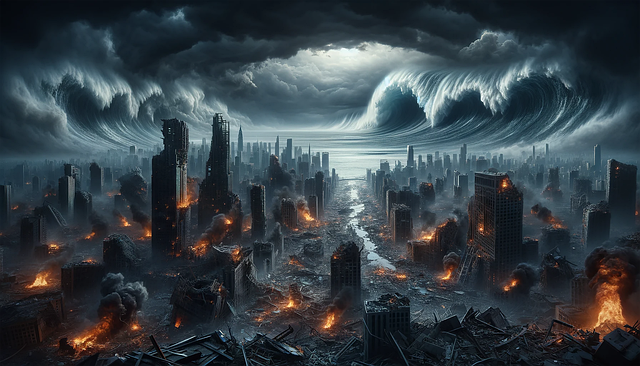
 The ‘Doomsday Clock’ is now 85 seconds to midnight — the closest it’s ever been.What scientists say this means for humanity and how the time is determined.Kate Murphy , Reporter Tue, January 27, 2026 at 3:22 p.m.UTC 4 min read
Add Yahoo as a preferred source to see more of our stories on Google.
Doomsday Clock (Getty Images) Humanity is closer to destroying itself, according to atomic scientists who revealed on Tuesday that the famous “Doomsday Clock” was set at 85 seconds to midnight — the closest it has been in the history of the clock.
The Bulletin of Atomic Scientists, a science-oriented advocacy group, made the announcement on Tuesday, metaphorically rating how close humankind is to annihilating itself with human-made advancements.
“It is the determination of the bulletin’s science and security board that humanity has not made sufficient progress on the existential risks that endanger us all.
We thus move the clock forward,” said Alexandra Bell, president and CEO of the Bulletin of the Atomic Scientists.“The risks we face from nuclear weapons, climate change and disruptive technologies are all growing.Every second counts and we are running out of time.”
Advertisement Advertisement Advertisement Advertisement Here’s a closer look at how the clock was created and how the time is determined.
🕛 What is the ‘Doomsday Clock’? It’s a symbolic way to show the public how close the Bulletin of the Atomic Scientists believes the world is to a human-made apocalypse.
Midnight represents Earth’s total annihilation.If the clock moves closer to midnight, it suggests that humanity is nearing self-destruction.
It is possible for the clock to move away from midnight, indicating that humanity has taken steps in the past year to reduce the risk of the end of the world.
“The Doomsday Clock is a design that warns the public about how close we are to destroying our world with dangerous technologies of our own making,” the website states .“It is a metaphor, a reminder of the perils we must address if we are to survive on the planet.”
↩️ How did the Doomsday Clock come about?
The 2025 Doomsday Clock time was set to at 89 seconds to midnight.(Kayla Bartkowski via Getty Images) The metaphorical timepiece concept dates back to 1947, when nuclear weapons were the greatest danger to humanity, as the United States and Russia were headed toward an arms race.
Advertisement Advertisement Advertisement Advertisement Artist Martyl Langsdorf was commissioned to design a new cover for the Bulletin of the Atomic Scientists journal.She was married to Alexander Langsdorf, a nuclear physicist who worked on the Manhattan Project, which built the world’s first atomic bombs.
She listened to the scientists who worked on the nuclear bomb, and they stressed the importance of conveying a sense of urgency to the public about the consequences of the new technology.
It was then that Langsdorf switched her design from the uranium symbol to a clock to convey that there’s not much time to get it under control.
The artist first set the Doomsday Clock to seven minutes until midnight because “it looked good to my eye,” she said.
☢️ How is the time determined? After the clock concept was established, Bulletin editor Eugene Rabinowitch decided whether or not the clock’s time should be adjusted.As a scientist and a leading voice in the international effort to reduce and eliminate nuclear weapons, he based his decisions on the clock’s time after consulting with other scientists and experts from all over the world.
Advertisement Advertisement Advertisement Advertisement After Rabinowitch died in 1973, the Bulletin’s governing board took over the responsibility.In 2008, a separate Science and Security Board (SASB) was established and is now entrusted with the task.The SASB is composed of a select group of globally recognized leaders who consult with additional experts across a wide range of disciplines.The board weighs the risk of nuclear disaster and, in recent decades, has considered threats from climate change and AI.
The members weigh the following two questions every year in deciding where the clock should be: Is humanity safer or at greater risk this year than last year? Is humanity safer or at greater risk than it was 78 years ago, when the clock was set?
⚠️ What was the time set to in recent years? In January 2023, the Doomsday Clock was set at 90 seconds to midnight, the closest to midnight it has ever been, in large part because of the nuclear threat posed by Russia’s war on Ukraine.
It remained at 90 seconds to midnight in 2024, citing the Oct.7, 2023, attack on Israel and the war in Gaza, disasters exacerbated by climate change and the danger of artificial intelligence .
Advertisement Advertisement Advertisement Advertisement In 2025, the clock was set at 89 seconds to midnight , the closest it has ever been to midnight in its 78-year history.
Scientists said it was because of the war in Ukraine as well as “nuclear risk, climate change, biological threats and advances in disruptive technologies.”
🕦 When was the clock furthest from midnight?
Dr.Leonard Rieser, Chairman of the Board of the Bulletin of the Atomic Scientists, moves the hand of the Doomsday Clock back to 17 minutes before midnight on Nov.26, 1991.
(Chicago Tribune via Getty Images) In 1991, the Bulletin set the clock back to 17 minutes until midnight, gaining seven minutes after the Cold War was officially over.The U.S.and Russia signed the Strategic Arms Reduction Treaty (START), agreeing to greatly reduce the number of strategic nuclear weapons.
Since first appearing in 1947, Martyl’s Doomsday Clock has been reset more than 20 times.
Advertisement About Our Ads.